
computer robotics
المستويات الدراسية: Grade 5
النظام التعليمي: National English
robotics and details
#robotics
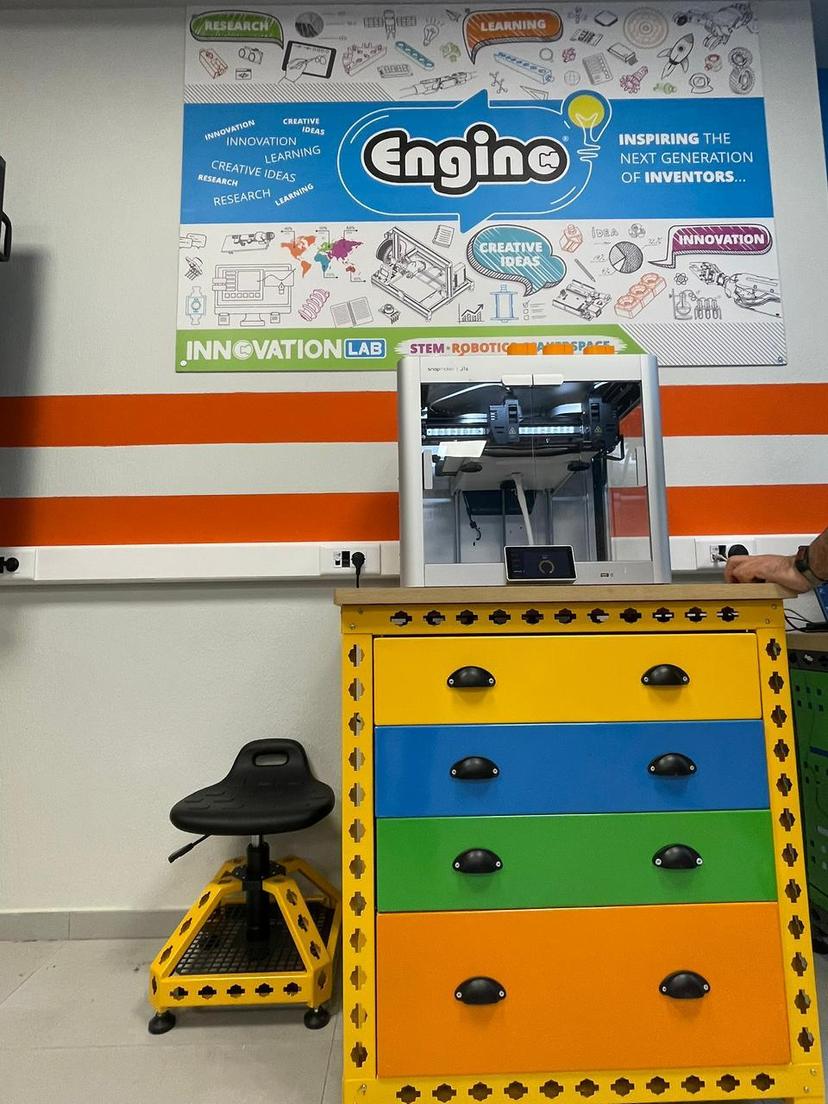
robotics and details
#robotics
1. Define standard robotics terminology (e.g., degree of freedom, actuator, sensor, end effector, mobile base) and use terms correctly in written and oral explanations.
2. Classify at least three robot architectures (wheeled mobile, legged, manipulator) and justify component choices for a given application scenario.
3. Diagram coordinate frames for a simple robot and compute 2D/3D frame transforms using homogeneous transformation matrices for at least two example poses.
4. Apply lab safety procedures (PPE, power isolation, current limiting, emergency stop) during build and test activities without violations across three lab sessions.
5. Summarize ethical and societal considerations (risk assessment, privacy with cameras, human–robot interaction) and propose at least two risk mitigations for a given use case.
1. Wire DC motors via an H-bridge motor driver, wheel encoders, and an ultrasonic sensor to the microcontroller according to datasheets; verify continuity and correct polarity with a multimeter.
2. Configure the toolchain (Arduino IDE or PlatformIO), flash firmware, and confirm bidirectional serial telemetry at a specified baud rate.
3. Program GPIO and PWM to drive motors and implement encoder interrupts achieving a stable sampling rate (≥100 Hz) with missed-interrupt rate <1%.
4. Implement sensor polling and publish timestamped telemetry over UART/USB at ≥10 Hz; log at least 2 minutes of data without buffer overruns.
5. Enforce electrical and operational safeguards (current limiting, motor enable/disable, emergency stop) and demonstrate safe shutdown on command or fault.
1. Derive forward and inverse kinematics for a differential-drive platform and compute pose updates from wheel tick counts over a recorded trajectory.
2. Implement discrete-time PID velocity control for each wheel; tune gains (e.g., Ziegler–Nichols or step-response) to achieve rise time and overshoot within given bounds.
3. Integrate odometry at ≥20 Hz and estimate robot pose; compute RMSE against ground-truth markers staying below a specified threshold (e.g., <0.1 m over 5 m).
4. Compare open-loop versus closed-loop tracking by generating plots in Python/Matplotlib or MATLAB; report quantitative improvements in steady-state error and disturbance rejection.
1. Calibrate IMU (biases/scale) and align sensor frames; verify post-calibration drift within specified limits over a 2-minute static test.
2. Implement a complementary or Kalman filter to fuse wheel odometry and IMU for heading estimation; quantify reduction in heading error versus individual sensors.
3. Process LiDAR or ultrasonic readings to detect obstacles between 0.2–2.0 m and publish occupancy information; measure precision and recall on a defined test course.
4. Implement a basic computer-vision task (e.g., line or ArUco marker detection) in OpenCV and maintain detection performance under at least two lighting conditions.
1. Create a ROS 2 package with nodes, messages, and launch files; build with colcon without errors and run nodes using ros2 launch.
2. Simulate the robot in Gazebo with appropriate kinematics and noise models; validate TF tree integrity (base_link, odom, map) using tf2 tools.
3. Generate a 2D occupancy grid via SLAM (e.g., GMapping or RTAB-Map) and save the map for reuse; verify coverage and resolution against the simulated environment.
4. Configure AMCL for localization and achieve median pose error below a specified threshold on a validation route visualized in RViz.
5. Implement a global planner (A*/Dijkstra) and a local planner (e.g., DWA/TEB) to reach multiple waypoints while avoiding obstacles; report success rate and path length.
1. Design subsystem and system-level test plans with measurable acceptance criteria covering control, perception, and navigation; execute and record outcomes.
2. Benchmark key metrics (tracking error, mapping error, navigation success rate, energy consumption) and present results with plots and concise analysis.
3. Conduct a failure modes and effects analysis (FMEA) and implement mitigations (watchdog timers, bounds checking, failsafe stop); demonstrate at least one mitigation in operation.
4. Use Git to manage code revisions and issues; integrate basic CI tests or linting and produce a clear README with build, run, and safety instructions.